




Blog: Category Archives: Technology & Innovation
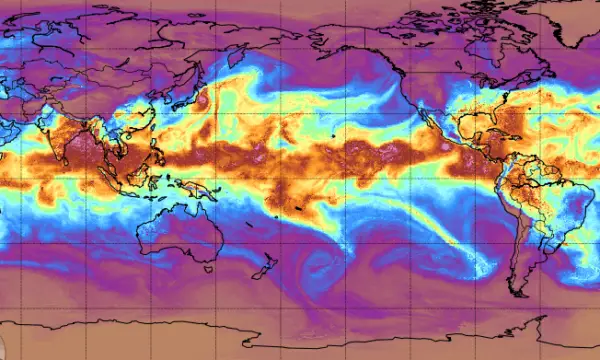
UC San Diego’s GAIA Initiative Promises Transformation of Atmospheric and Climate Research
The realization that predictive climate research could be transformed by networked compute and data resources led to a breathtaking variety of research institutes in California. The next step is to accelerate this transformation by coordinating the institutes themselves so that they can each act as force multipliers for one another and for atmospheric, ocean, and climate research as a whole. That is the purpose of UC San Diego’s GAIA Initiative.

CENIC Members Doing the Impossible in Weather and Climate Forecasting with CENIC AIR and Advanced Networks
Vastly improved bandwidth and the emergence of AI-enabled tools—such as those made possible for CENIC members with CENIC AIR and NRP—have created a whole new era in weather prediction, climate modeling, and disaster preparedness.

Reimagining Supercomputing with the Distributed Bring-Your-Own-Resources Model
As society becomes more reliant on large-scale supercomputing centers for compute and storage, the costs associated with them have become a topic of discussion. One innovative hypercluster model—a distributed one—provides an alternative approach.

The CENIC AI Resource Powers Diverse Disciplines at CENIC Member Campuses
Learn how researchers at non-R1 institutions or those who need only a handful of GPUs can benefit from CENIC AIR, which can catapult their work to the next level and enable them to collaborate and compete with peers from larger, better-resourced institutions.

Network Strategies to Predict, Plan, and Prepare for Disasters
At the recent CENIC 2026 biennial conference, a panel of national networking experts discussed what disaster response means for major research and education networks, including proactive planning to ensure that critical connections and services are maintained when needed most. The panel was moderated and led by Louis Fox, Chief Executive Officer of CENIC.

AI-Enabled Fiber-Optic Geodesy: CENIC Networking and Services Enable Cutting-Edge Seismology
Using Caltech's Zhan Group of Observational Seismology as an example, you can learn how CENIC members and CENIC AIR participants have much of what they need to carry out cutting-edge AI-enabled vulcanology and seismology.

CENIC and San Diego Supercomputer Center Create Sustainable Agriculture for California’s Future
CENIC’s networking and services, including CENIC AIR, can be a vital part of preparing new generations of farmers that will apply the latest technology to agriculture by turning the farm into an educational setting and improving the efficiency of farming as a career.

CENIC Members Enable Data-Driven Agriculture: Optimizing Harvests in a Changing Environment
The use of technology in agriculture to increase yield and decrease resources is the focus of an innovative project fueled by CENIC and its collaborative partners: a novel model of precision agriculture in the vineyards.
Explore the Future with Jupyter Notebooks and CENIC AIR
Jupyter notebooks are key tools for various research and data science tasks, such as exploratory data analysis (EDA) and scientific analysis, and educational uses. CENIC members are in an ideal position to use Jupyter Notebooks with the CENIC AI Resource (CENIC AIR).

NRP’s Vision: Open National Infrastructure for Research & Education Beyond R1 Institutions
The long-term goal of the National Research Platform (NRP) is an open national infrastructure allowing the federation of cyberinfrastructure at all the nation’s higher education institutions, nonprofit research institutions, and national libraries.