



AI-Enabled Fiber-Optic Geodesy: CENIC Networking and Services Enable Cutting-Edge Seismology
CENIC’s biennial conference “The Right Connection” is fast approaching, and with it the Innovations in Networking Awards. These awards recognize CENIC members and others who have made extraordinary use of the bespoke high-performance networking and services that CENIC provides.
It’s worth noting, however, that these projects continue to develop in exciting ways after receiving the awards. One such project honored with the Innovations in Networking Award for Experimental Applications at our previous conference is the Caltech Zhan Group of Observational Seismology’s research on the use of fiber-optic cables as seismic sensors—and they have not been idle.
Thanks to the efforts of the Zhan Group and others, microscopic imperfections in fiber-optic cables—including subsea cables—have been transformed into millions of networked individual seismometers needing scientific equipment only at the endpoints, and that can sense tiny movements of the Earth’s crust. This gives scientists a detailed real-time view of ground, ocean floor, and magma movement, revealing fault structures and volcanic activity.
However, this sudden and massive increase in the number of seismic sensors has resulted in an equally massive surge in data generated, making the development of artificial intelligence (AI)-enabled tools a high priority for seismologists around the world. The Zhan Group’s Zhongwen Zhan has insightful perspectives about meeting this need, where the most progress is being made using these tools, and what the future holds for seismology.
When Everything Is a Sensor, Creativity Becomes the Bottleneck
In 2010, US Air Force Lt. Gen. David Deptula made his prescient comment about “swimming in sensors and drowning in data.” However, even Deptula likely never dreamed that 16 years later, nearly anything might potentially serve as a sensor. Ambient sounds, including conversations, can now be reconstructed from the imperceptible vibrations of windows and nearby objects. Unseen occupants in a room can be partially imaged by their reflections on surfaces once thought to be non-reflective, like doors and walls.
The discovery that microscopic imperfections in fiber-optic cables had potential as movement sensors—registering everything from seismic and volcanic activity to thunder and passing traffic—has increased the number of deployed movement sensors from thousands to tens of millions almost overnight, including under the oceans, with practically no end in sight. As Zhongwen Zhan states, “We hope to do this very thoroughly with CENIC’s California Research and Education Network (CalREN) and the world’s other networks and fiber-optic cables, but that will generate tens of petabytes of data, all of which will need to be processed and managed before discovery can take place.”
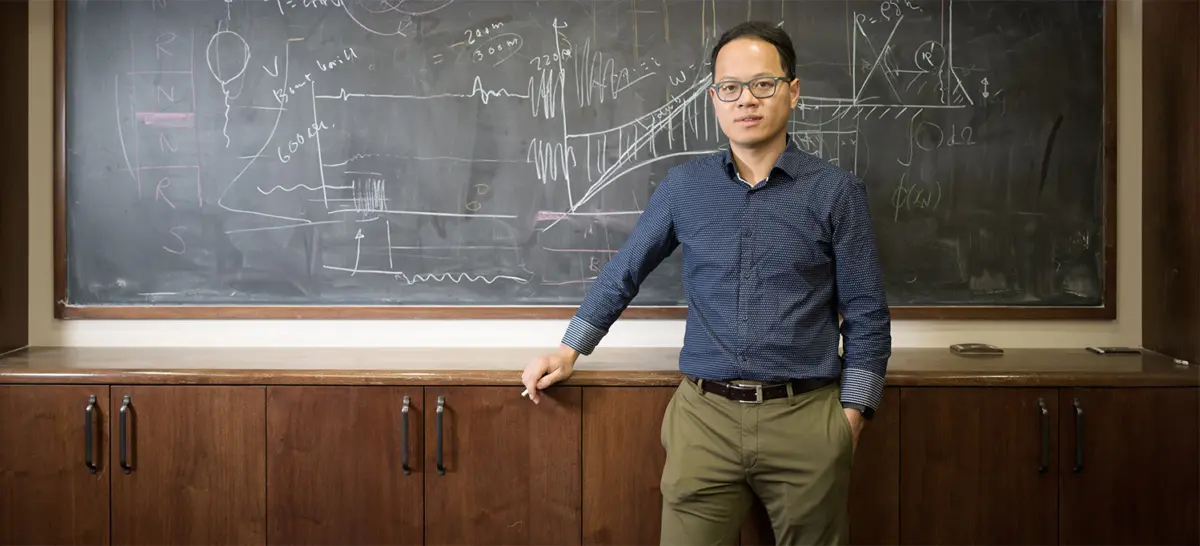
This astonishing new abundance of sensors and the data they generate makes human creativity the most precious resource—and thus the narrowest bottleneck. Thankfully, AI tools can help relieve this constraint. As Zhan puts it, “Creative scientists are rare. That means for now, one of the most useful applications of AI tools for seismology is initial data processing, which frees up scientists’ most scarce resource: their time.”
Finding Patterns in Petabytes: Seeing New Forests for Trillions of Trees
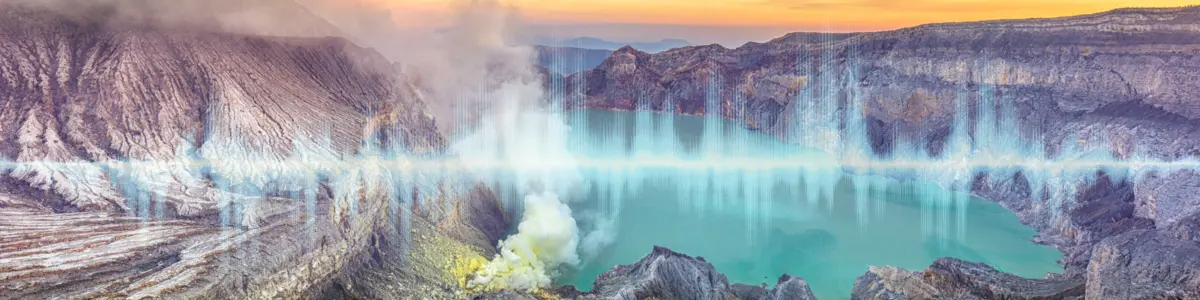
The sudden increase in seismic sensors presents yet another challenge: discerning whole new forests among orders of magnitude more trees. Many paradigm-shifting discoveries are likely lying dormant in the patterns hidden within both old and new data, simply because researchers have not yet performed the millions of needed comparisons. Without a prior reason, it can be difficult to justify the research and computing time needed to find unanticipated revolutionary patterns.
“AI’s not the only tool for this,” Zhan observes, “but it’s a good one. We can use it to find new patterns, some of which might translate into useful applications that we can’t currently imagine. AI is a great way to find things you don’t even know you should be looking for.”
There is also the "More Is Different" effect, first named by physicist Philip Anderson in his 1972 article in "Science." Exponentially more sensors don’t just increase the volume of data and analysis required; finer levels of detail can introduce entirely new kinds of analysis. Vastly more seismic sensors provide a view into earth movements, faults, ruptures, subsurface magma, and more at an unprecedented level of detail, which will spur new questions and entirely new areas of research. Seismology itself will be transformed, and completely new disciplines will emerge. The Zhan Group is already developing AI-enabled tools specifically designed to process data at finer and finer levels of detail, with an eye to creating those new disciplines.
Recent Results: Successfully Predicting Volcanic Eruptions in Iceland
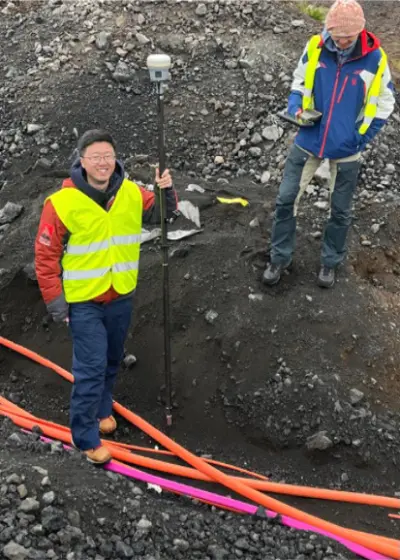
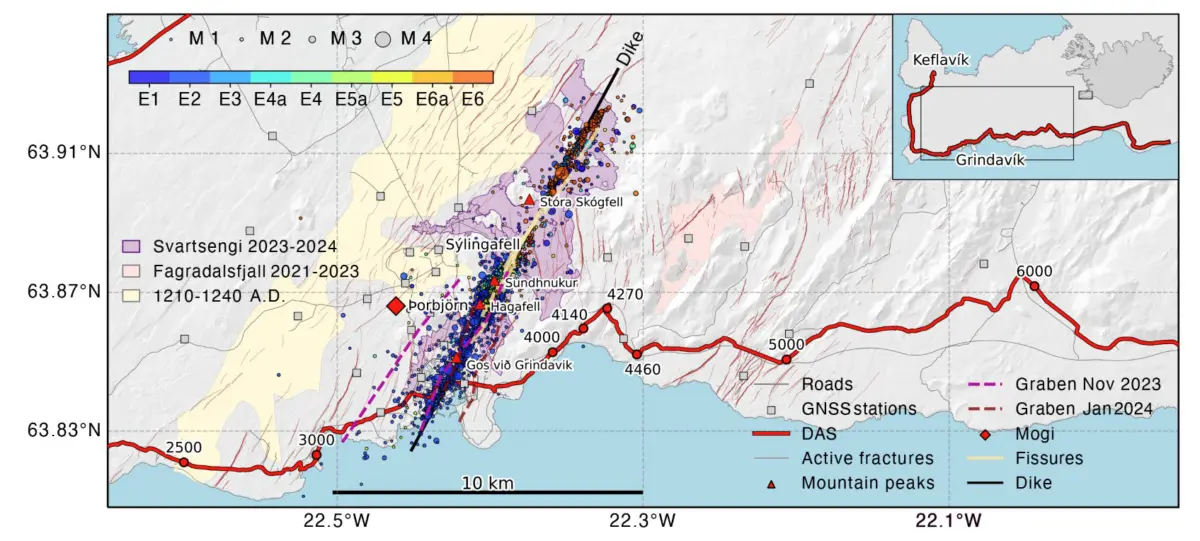
This approach is already bearing valuable fruit, as demonstrated in a 2025 paper titled “Minute-scale dynamics of recurrent dike intrusions in Iceland with fiber-optic geodesy.” (Participating institutions include CENIC members Caltech—with members of the Zhan Group shown in Iceland at right—and the Jet Propulsion Laboratory, the University of Iceland at Reykjavik, the University of Houston, Google, and others.)
By using fiber-optic cables as movement sensors—a technique known as fiber-optic geodesy—the researchers were able to detect the movement of underground magma 30 minutes to an hour before it erupted onto the surface. While earthquake prediction remains elusive, the application of fiber-optic geodesy combined with AI-enabled tools is extremely promising for the prediction of volcanic eruptions. As Zhan notes, “When it comes to volcano prediction, we know that if we have enough data, we can do it; we saw the signal on the fiber. And earlier warnings can give people in volcanically active areas valuable time to evacuate themselves and their families.”
Cables, Data Storage and Processing, Access: CENIC Services Speed Progress
It’s almost uncanny how perfectly the tools required by the new discipline of fiber-optic geodesy align with the benefits CENIC provides to its member researchers. First, the fiber-optic cables of the CalREN backbone itself contain millions of connected sensors in a high-performance network. Seismic and volcanic data must be transmitted in real time for early warning systems to be effective. The ubiquity of data access enabled by advanced networking has allowed seismology to grow from a relatively small field to one where any institution with a geosciences program now employs at least one seismologist.
For example, despite the Zhan Group being a ten-person team, Zhan “cannot imagine we’ve extracted everything that can be gotten out of our data sets.” He adds, “Once we’re at the scale we’re aiming for, researchers will be able to examine our data and generate value we don’t imagine now." He anticipates collaboration with the National Data Platform (NDP) in the future, enabling bleeding-edge seismic research for any CENIC member participating in the CENIC AI Resource (CENIC AIR).
“We very much want to set an example for other researchers by creating models for how to achieve this. It’s a classic government/industry/academia collaboration that benefits everyone.”
Second, CENIC AIR provides researchers and faculty at all participating institutions with the data storage and processing power needed to create, store, and share data and AI- and machine-learning-enabled tools. This aligns with Zhan’s own observation that, “In the future, cooperative, large-scale AI platforms will be indispensable.”
Lastly, CENIC’s global partnerships with other research and education networks—such as initiatives like the National Research Platform (NRP), Pacific Wave, and others—enable the global collaborations that seismology requires. “That’s the reason why seismology is such an open community,” Zhan stated with a smile. “Quakes don’t respect boundaries.”
If you’d like to learn more about how researchers and faculty at CENIC member institutions are making use of CENIC’s networking and services, consider registering to attend our biennial conference “The Right Connection” from March 29 to April 1, 2026, in Monterey, CA. While there, you’ll enjoy a program created by and for members of the CENIC community, casual human networking, demos, workshops, and the presentation of the 2026 Innovations in Networking Awards. Visit the conference website to view the program, register, and make your hotel reservations.
Related blog posts
UC San Diego’s GAIA Initiative Promises Transformation of Atmospheric and Climate Research
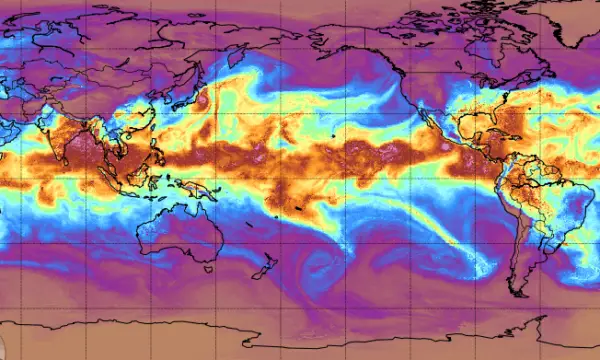
The realization that predictive climate research could be transformed by networked compute and data resources led to a breathtaking variety of research institutes in California. The next step is to accelerate this transformation by coordinating the institutes themselves so that they can each act as force multipliers for one another and for atmospheric, ocean, and climate research as a whole. That is the purpose of UC San Diego’s GAIA Initiative.
CENIC Members Doing the Impossible in Weather and Climate Forecasting with CENIC AIR and Advanced Networks
Vastly improved bandwidth and the emergence of AI-enabled tools—such as those made possible for CENIC members with CENIC AIR and NRP—have created a whole new era in weather prediction, climate modeling, and disaster preparedness.

Recent blog posts
UC San Diego’s GAIA Initiative Promises Transformation of Atmospheric and Climate Research
Reimagining Supercomputing with the Distributed Bring-Your-Own-Resources Model
The CENIC AI Resource Powers Diverse Disciplines at CENIC Member Campuses
Experts Review Developments in Federal Funding Landscape at CENIC 2026 Conference
Subscribe to our newsletter
Stay up to date on news and stories from the CENIC community.