




Network Strategies to Predict, Plan, and Prepare for Disasters
When disasters occur, whether natural or man-made, they can seem random and unpredictable and often damage the very infrastructure needed during recovery. However, for those who manage research and education (R&E) networks and those they serve, disaster response means proactive planning to ensure those critical connections and services are maintained when needed most. CENIC’s experience with disaster recovery in its thirty-year history was the foundation for a panel of network experts convened at the CENIC 2026 biennial conference, The Right Connection.
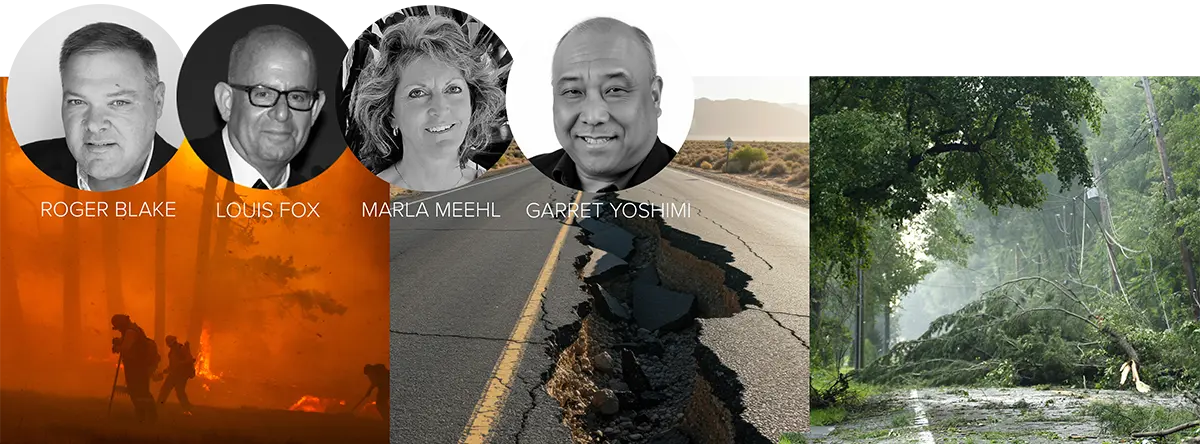
The panel was moderated and led by Louis Fox, Chief Executive Officer of CENIC, and featured Roger Blake, President and CEO of Merit Network, the nonprofit R&E network for Michigan’s public universities; Garret Yoshimi, Vice President of Information Technology and Chief Information Officer at University of Hawai’i; and Marla Meehl, Integrated Network Services Manager and Assistant Director of Enterprise IT with the University Corporation for Atmospheric Research (UCAR) which manages the National Center for Atmospheric Research, or NCAR.
R&E Networks: Critical Infrastructure During Disasters
Fox launched the panel, noting the key role resilient networks play during disaster response by connecting those experiencing the threat and those working to help.
“CENIC as an organization has risen to a variety of occasions that have challenged our network and our members in our history, with the help of our many partners,” said Fox. “We sustain the commitment to continue growing our capacity to prepare for and respond to emergencies. It is one of the hallmarks of our mission to sustain our reputation as a well-managed and innovative network.”
Panelists focused on the role R&E networks play in connecting the scientists and experts who study emerging disaster threats with those trained professionals who respond. After all, it’s the world’s networks and peering infrastructures that empower these researchers and responders as well as those affected who face a long and daunting recovery process.
Fox highlighted the important role of regional network organizations as well. “CENIC participates in a number of regional networks, one of which is the Western Regional Network, a very important research-focused infrastructure for the West, one of the most important resources on which is NCAR,” said Fox.
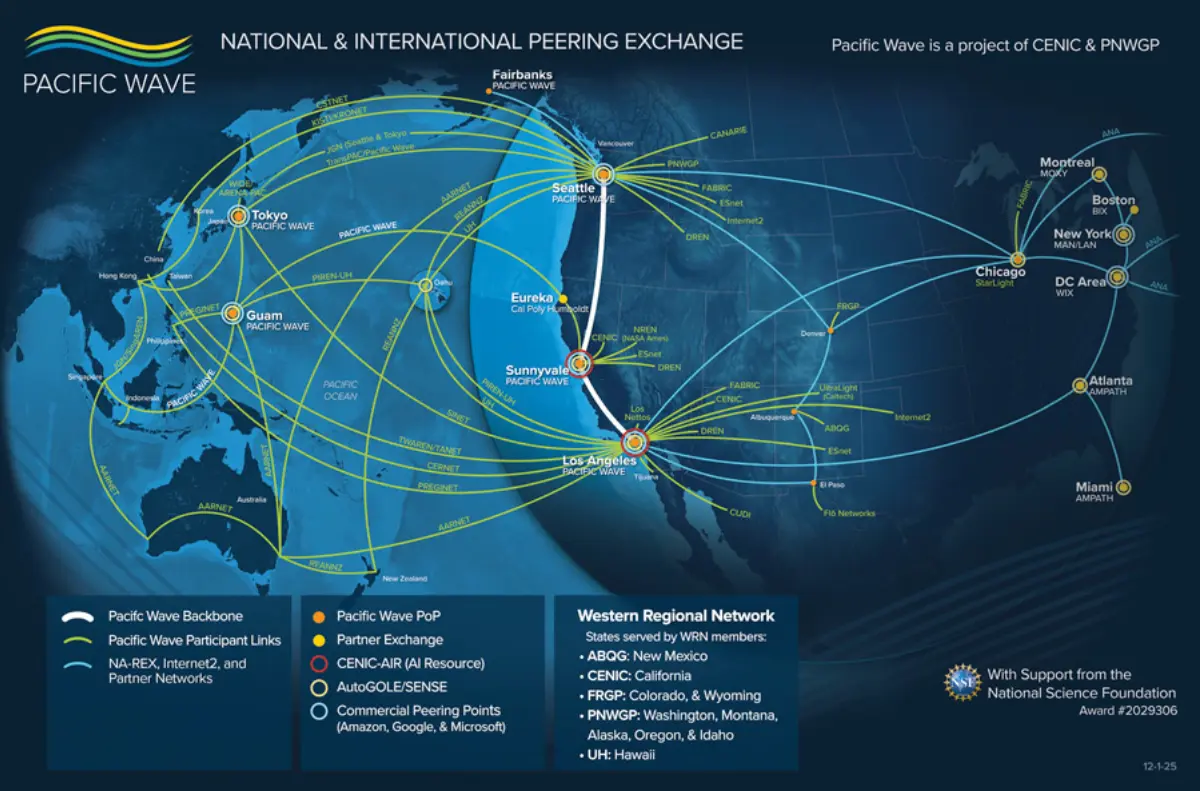
Global connectivity for researchers in the American West is provided through additional connections between CENIC and other networks via Pacific Wave (shown below). “Pacific Wave is a distributed international peering infrastructure that CENIC runs together with the Pacific Northwest Gigapop,” explained Fox. “It connects the many regional and national research networks in the US and beyond through the Pacific Rim to one another, and has been extremely important in terms of disaster response since many of the nations are in the ‘Ring of Fire.’ Pacific Wave also proved itself to be a critical infrastructure during the COVID pandemic as well as for climate-related events.”
Fox then highlighted the University of Hawai’i’s (UH) decades of effort in connecting Oceania and Asia to the continental US, mentioning the CENIC 2026 Innovations in Networking Award for Network Partner, which was given to UH’s David Lassner and panelist Garret Yoshimi, along with their colleague Chris Zane, during the conference.
Capacity and Resilience: Keys to Fast, Effective Response
Panelists agreed that building capacity and resilience into networks with multi-route diversity and redundancy is critical to sustaining services despite wildfires, earthquakes, floods, extreme weather, or even volcanoes. Their comments also illustrated the variety of emergencies to be found in different locations, as well as how they impact each location’s responses and priorities.
“Trunk resilience is key, as well as a focus on our human capital,” said Garret Yoshimi, who recounted the impact of the 2022 lava flow that cut off access to the Mauna Loa Solar Observatory. “The lava not only covered the road, it also cut off power to the observatory that provides critical information to a network of universities and government agencies. The only access was by helicopter until this year.”
Yoshimi also addressed the impact of the destructive “Kona Low” storm that struck Hawai’i in early March 2026. The storm dropped a staggering 3,000% of the state’s annual rainfall in less than three weeks and left many residents and institutions flooded and without power for extended periods of time.
Resilience in power and human capital via partnerships was also a priority for all panelists. Yoshimi and his fellow panelists noted that natural disasters affect entire communities, including those who work to bring back power and connectivity to the network. “When a disaster hits, we need to make certain that our people are safe and secure before we can put all our efforts into getting connectivity back,” explained Yoshimi.
Michigan’s original plan to expand wired connectivity to the entire state started with connections mostly above ground to reduce build costs but now has shifted based on the impact of recent powerful tornadoes, followed by extreme snow. “Our plans to wire the state above ground have changed, and it’s ironic that our ‘Reach Higher’ project is now going underground,” said Roger Blake, who explained that burying the fiber along the same routes is better for resiliency, given the weather events common in the state.

One Step Ahead of Disaster: Monitoring and Prediction
Much of Marla Meehl’s work through UCAR and the US National Science Foundation’s NCAR, which is managed by UCAR, involves the predictive science that enables first responders to prepare for impending natural disasters. Her organization provides critical analysis from a wide variety of data sources, including observatories, the National Oceanic and Atmospheric Administration (NOAA), and universities, to inform and train scientists to better understand the impacts of such events on our atmosphere.
“I was really impressed with the USGS’ ability to predict the 2022 Mauna Loa eruption,” said Meehl, referring to the US Geological Survey’s Hawai’ian Volcano Observatory. She also spoke of tracking vast smoke plumes from wildfires to give communities time to prepare—and emphasized such events’ broad reach. “We know wildfires don’t stop at state borders. We’re all in this together.”
NSF NCAR’s work extends beyond Earth’s atmosphere with facilities like the Mauna Loa Solar Observatory mentioned earlier by Yoshimi. Data from the observatory enables scientists and responders to monitor changes in solar weather that might damage or even take down large power grids and communications. “We provide research that allows everyone to prepare and predict what the impact of these events will be,” said Meehl.
Stronger Together: The Value of Partnerships
All panelists noted the importance of relationships with other partners including private industry to bolster the redundancy communities need when a disaster strikes. “We can be a little insular as nonprofits, but there are a lot of other infrastructure owners, and we need to make sure we’re talking to each other,” said Blake.
Yoshimi seconded the value of collaboration, noting that the Asia Pacific Oceania Network (APOnet) is looking to engage with major tech companies, creating a networked mesh that overlays much of the trans-Pacific research and education networks.
“Accidents can happen with cable under the ocean. Cables get cut, stuff gets shut down and stops working,” said Yoshimi. “We need multiple paths to ensure resiliency and redundancy to sustain connections.”
Looking to the future, panelists spoke of building relationships beyond tech corporations to help expand the network of responders for predictable disasters.
“We’ve engaged with the Information Technology Disaster Resource Center (ITDRC), which operates nationally. It’s an excellent resource,” said Blake. “And we have developed a community assistance pact which works like a mutual-aid agreement to identify campus responders who will understand the issues and help each other out in times of need.”
“We do need sufficient human capital and excess capacity,” agreed Yoshimi.
The panelists ended their discussion by pointing out funding challenges for areas of science that are not well understood.
“The research we do enables us all to have a better understanding of where we need to be resilient and where the risks are. This knowledge allows community planning, adaptation, and mitigation efforts before, during, and after disasters,” stated Meehl.
The entire panel discussion, including topics such as long-term investments and potential obstacles, can be found on CENIC’s YouTube channel, along with other helpful programming from our 2026 biennial conference. Keep an eye out for future news via our newsletter and other updates.
Related blog posts
CENIC Members Enable Data-Driven Agriculture: Optimizing Harvests in a Changing Environment
The use of technology in agriculture to increase yield and decrease resources is the focus of an innovative project fueled by CENIC and its collaborative partners: a novel model of precision agriculture in the vineyards.

Product Testing and Validation Testbeds as a Service over Middle-Mile Infrastructure
To vendors, service providers, or research teams, extensive middle-mile fiber infrastructure can play the role of an elastic testbed that matches real-world production networks.

Recent blog posts
UC San Diego’s GAIA Initiative Promises Transformation of Atmospheric and Climate Research
Reimagining Supercomputing with the Distributed Bring-Your-Own-Resources Model
The CENIC AI Resource Powers Diverse Disciplines at CENIC Member Campuses
Experts Review Developments in Federal Funding Landscape at CENIC 2026 Conference
Subscribe to our newsletter
Stay up to date on news and stories from the CENIC community.