




The CENIC AI Resource Powers Diverse Disciplines at CENIC Member Campuses

In Brief
- In 2025, CENIC AIR had an average of 600 unallocated GPUs available at any one time
- Only a few GPUs can enable researchers at non-R1 institutions to compete and cooperate with colleagues at R1s
- CSU Northridge, Cal Poly Humboldt, and Cal Poly SLO researchers made big leaps in image denoising, immune cell classification, and reptile genomics with modest numbers of GPU-hours
- CENIC AIR simplifies grant-writing by giving you access to resources you need as part of your existing CENIC membership
What's Next
- Watch Larry Smarr's entire CENIC conference talk on YouTube for more examples of turbocharged research thanks to CENIC AIR
- Contact your PMO representative or the CENIC NOC to learn more about connecting to CENIC AIR
At the turn of the millennium, network specialists were already considering how fiber-based networks might function as a continent-sized backplane, connecting far-flung compute, storage, and I/O resources at the speed of light.
These musings included CENIC’s California Research and Education Network (CalREN), a multi-tier high-performance fiber-based network comprising more than 54,000 miles of CENIC-managed fiber, of which some 8,000 miles form the CENIC-owned network backbone. For the last three decades, CENIC and CalREN have placed CENIC member institutions at the forefront of the distributed networking revolution.
Many networking and scientific experts foresaw this future, but few were as prescient and impactful as UC San Diego Professor Emeritus Larry Smarr. At the CENIC 2026 biennial conference, “The Right Connection,” Smarr guided attendees through this digital ecosystem and then through a diverse set of research projects made possible by it.
Smarr was the Principal Investigator (PI) of the NSF Pacific Research Platform (PRP) awarded in 2015, which created a distributed academic compute and storage cloud. The PRP was built using CENIC and other regional research and education networks (RENs) as the academic cloud’s optical backplane, while adopting through open source the same Kubernetes automated software system that is used by the commercial clouds to orchestrate the deployment, scaling, and management of researchers’ containerized applications.
The PRP transitioned into the National Research Platform (NRP) in 2023, with PRP co-PI Frank Wuerthwein (San Diego Supercomputer Center Director) becoming the NRP lead. Today NRP counts 82 institutions among its members, who contribute 126 data centers containing 1,465 GPUs and 31,978 CPUs, in addition to Petabytes of storage resources, all available for free to academic researchers and students.
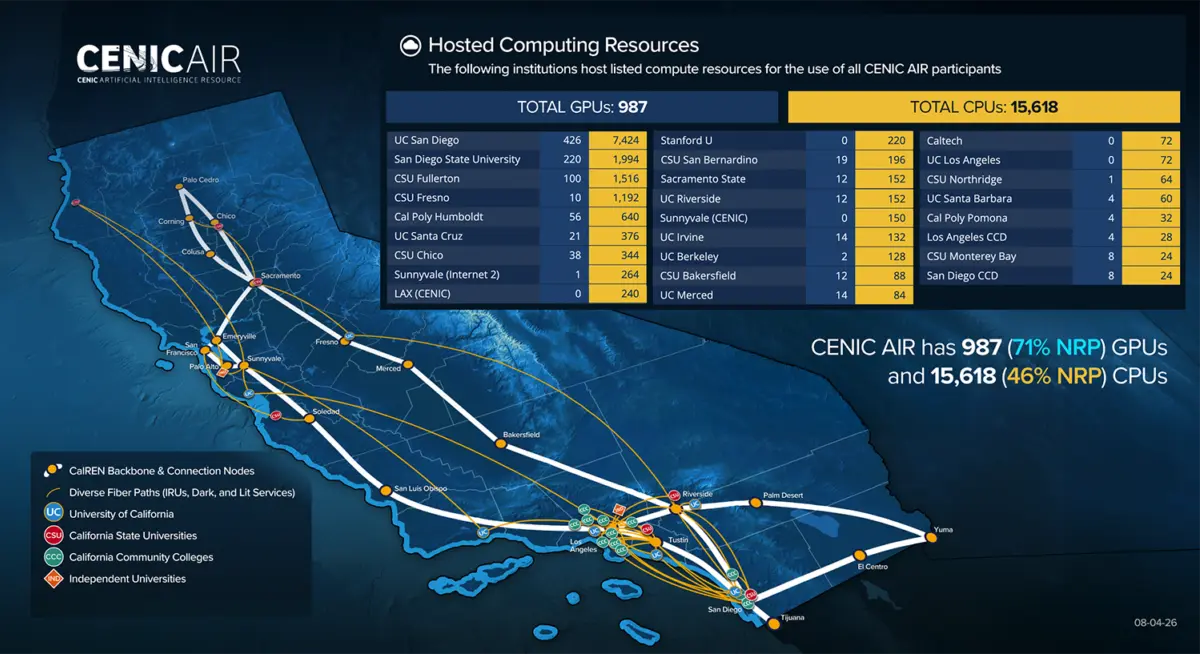
The CENIC AI Resource: A Supercomputer Called California
The CENIC AI Resource (CENIC AIR), the California portion of the NRP, has been operating as a persistent resource since 2024. CENIC AIR’s nearly 15,000 CPUs (~1/2 of the NRP CPUs) and over 1000 GPUs (~3/4 of NRP GPUs), along with Petabytes of rotating storage are housed in rack mounted PCs in the many machine rooms of CENIC member institutions. These CENIC AIR resources are connected over CalREN, forming a research-and-education-focused hypercluster optimized for the development and use of AI and machine learning (AI/ML) tools, all of which are free to use for CENIC members.
Abundant Resources for Researchers at All Scales and Institutions
Smarr shared the following graph of the number of NRP GPUs requested daily by namespace during 2025, where each namespace is shown in a different color. (A “namespace” has a campus researcher PI and is a group of compute and storage resources in a cluster that has been specially set aside for a given set of projects by the PI.) During 2025, an average of 800 GPUs out of the NRP’s 1,465 were in daily use—meaning that over 600 GPUs were available for use by other participants on any given day.
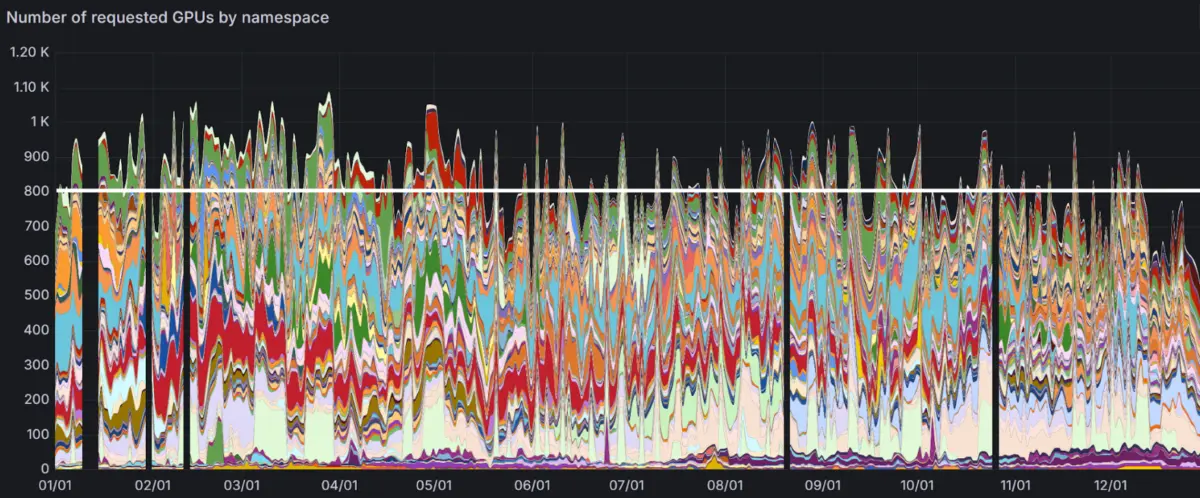
While Smarr’s presentation included several examples of GPU-hungry applications from two Carnegie-classified Research 1 (R1) university* researchers at Caltech and UC San Diego, he was careful to emphasize the potential of those 600 daily unallocated NRP GPUs for researchers at non-R1 institutions, where even a handful of GPUs allocated for a short while can catapult their work to the next level, as they could then collaborate and compete with peers from larger, better-resourced institutions. Notably, 44% of the institutions of higher learning in NRP’s membership are not R1 universities, highlighting CENIC AIR and NRP’s potential to expand access to AI/ML-focused infrastructure beyond R1 research-oriented universities.
In fact, CENIC AIR plays an especially important role in realizing this potential, as CENIC member institutions can explore participation in CENIC AIR and NRP as part of their membership with a simple phone call or email to CENIC’s Program Management Office or Network Operations Center.
One additional and very welcome benefit of CENIC AIR is that grant proposals from CENIC member campuses become simpler to write and more persuasive when researchers can assert that they already have access to the compute and storage they need, with even more on tap, as part of their CENIC membership.
* The Carnegie Classification R1, or Research 1, is a classification for universities that indicates very high research activity, requiring at least $50 million in total research spending and the awarding of at least 70 research doctorates annually.
Big Results with Few GPUs: Image Denoising, Immune Cells, Reptile Genomics
Smarr picked three CENIC AIR researcher examples from Cal State campuses to make clear how using even a small number of CENIC AIR GPUs can produce important research outcomes at non-R1 campuses.
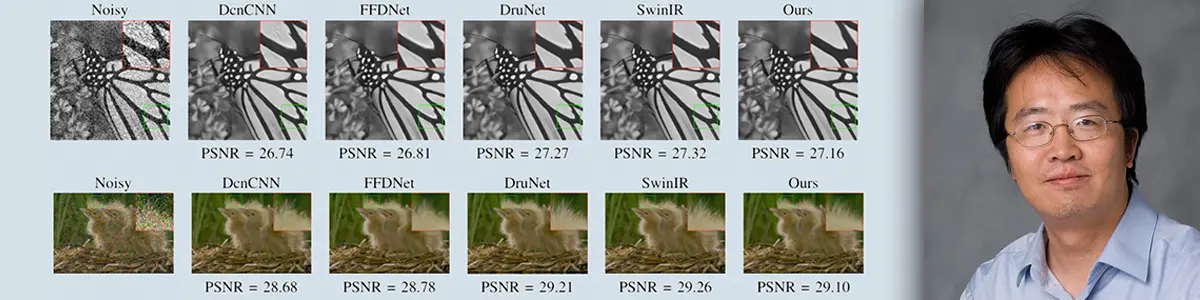
Example #1 CSU Northridge: Anyone who has squinted at a screen while picking bicycles or traffic lights out of a grid of blurry images has participated in a critical image recognition application: training AI models that control autonomous vehicles to recognize these objects as well as humans do. Identifying and classifying noisy images has many other applications as well, such as medical imaging, facial recognition, and environmental management, meaning removing image noise or “denoising” an image automatically with the use of AI tools is a very active field of research.
Thanks to CENIC AIR, CSU Northridge (CSUN) Professor of Electrical and Computer Engineering Xiyi Hang has made exceptional progress in this field using 13,000 CENIC AIR GPU-hours (peaking at only 5 GPUs) in 2025. Image-denoising deep-learning models require millions of parameters and are extremely difficult to train without GPUs. Since CSUN participates in CENIC AIR, Hang could access more than enough GPUs at no charge and moreover did not have to request grant funding for compute resources. Using CENIC AIR resources, he has developed a highly efficient image-denoising deep-learning model with performance comparable to large models developed at much larger institutions.
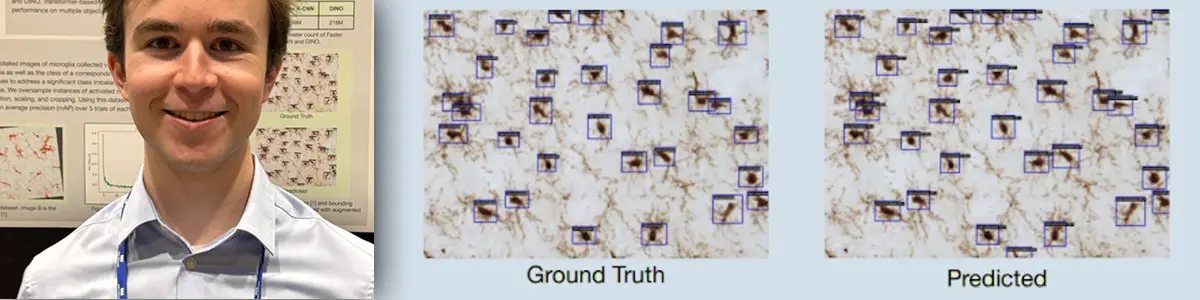
Example #2 Cal Poly Humboldt: It isn’t only faculty who make use of CENIC AIR to improve the identification and classification of images. While working under Cal Poly Humboldt Professor of Mathematical Biology Kamila Larripa, undergraduate John Gerving developed an automated system using computer vision to quantify immune cells peculiar to the brain. Gerving used 2,200 CENIC AIR GPU-hours (peaking at 21 GPUs) in 2025 to support his research. Immune cells in the brain, called microglia, come in many varieties, each designed to respond to different threats, for example, dying cells, harmful substances, misshapen proteins, and other debris. The proportions of the varieties of microglia present in an individual’s brain can be an important indicator of neuroinflammation. Gerving’s research was honored with the Mathematical Association of America’s 2025 Janet L. Andersen Award for Undergraduate Research in Mathematical or Computational Biology.
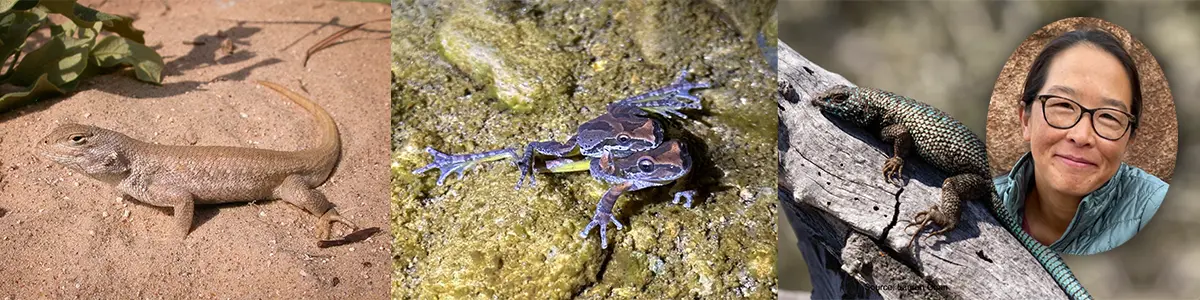
Example #3 Cal Poly San Luis Obispo: One particularly thrifty example of normally GPU-hungry genomics research—this one using only 253 GPU-hours (peaking at 6 GPUs) in 2025—is Cal Poly San Luis Obispo Professor Lauren Chan’s research on reptile genetics. Leveraging CENIC AIR and NRP resources, Chan’s team sequenced the DNA of reptiles found in New Mexico and Texas to determine the history, adaptations, and connections between populations—a difficult challenge, given the enormous size of reptile genomes. Chan plans to apply what her team has learned to conduct further research in California’s Channel Islands.
CENIC AIR is also very useful when researchers are ready to move past the training stage of their AI models, which typically requires fewer GPUs, and scale up into working with larger datasets. The existence of so many unallocated NRP GPUs makes this scaling process much more feasible.
A Fast-Growing, Sustainable Ecosystem for a Dizzying Variety of Disciplines
Smarr concluded his presentation by considering what lies ahead for the ongoing expansion of CENIC AIR and NRP. A growing number of CENIC member campuses are choosing to participate in CENIC AIR, while the process of connecting is made much simpler in California thanks to CENIC’s engineering team, which stands ready to work with any member institution interested in connecting their campuses to CENIC AIR and NRP securely via a Science DMZ.
Many participating campuses also host resources for their own and other participants’ use as well. Any interested institution is welcome to contact CENIC’s Tom DeFanti to discuss housing equipment in their campus machine rooms or to make available to CENIC AIR already existing and networked equipment to other participants, while gaining access to CENIC AIR’s and NRP’s distributed resources for their own use.
As Smarr puts it, “More and more campuses are contributing equipment in their machine rooms already connected by CENIC. It’s almost a miracle—we are not spending hundreds of millions of dollars to build new datacenters, because California’s campuses already have the equivalent of many datacenters, all connected by CENIC at multi-Gigabit speeds!”
This model also simplifies expansion since many campus machine rooms contain unoccupied rack space. The distributed nature of using multiple campus machine rooms also sidesteps some of the challenges of large datacenters by distributing power and cooling loads throughout the CENIC membership in much smaller, more manageable amounts.
Smarr underlined the diversity of disciplines making use of CENIC AIR resources. Initially, researchers in traditionally big-data disciplines may have gravitated to CENIC AIR, but the infrastructure itself—and the ease with which CENIC members can access and use it—has enabled many other disciplines to discover their data-intensive potential as well.
“The AI and machine learning revolution,” Smarr said, “will leave no stone unturned. Every field will be transformed.”
If you or your institution would like to connect to CENIC AIR and NRP to enable your faculty and students to join the ranks of these CENIC AIR Champions, feel free to contact your representative in the CENIC Program Management Office or our Network Operations Center. We also encourage you to watch Dr. Smarr’s entire conference presentation on the CENIC News YouTube channel for even more impressive examples of faculty and student research enabled by CENIC AIR.
Related blog posts

CENIC Members Doing the Impossible in Weather and Climate Forecasting with CENIC AIR and Advanced Networks
Vastly improved bandwidth and the emergence of AI-enabled tools—such as those made possible for CENIC members with CENIC AIR and NRP—have created a whole new era in weather prediction, climate modeling, and disaster preparedness.

Reimagining Supercomputing with the Distributed Bring-Your-Own-Resources Model
As society becomes more reliant on large-scale supercomputing centers for compute and storage, the costs associated with them have become a topic of discussion. One innovative hypercluster model—a distributed one—provides an alternative approach.

Recent blog posts
Reimagining Supercomputing with the Distributed Bring-Your-Own-Resources Model
The CENIC AI Resource Powers Diverse Disciplines at CENIC Member Campuses
Experts Review Developments in Federal Funding Landscape at CENIC 2026 Conference
Celebrating Dr. Ben Izadi’s Leading Role in the CENIC and Cypress College Student Internship Program
Subscribe to our newsletter
Stay up to date on news and stories from the CENIC community.