





California at the Vanguard of AI-Enabled Education for All with CENIC AIR
CENIC’s biennial conference The Right Connection began with a statement by Keynote Speaker Frank Wuerthwein, director of UC San Diego’s San Diego Supercomputer Center, that was equal parts stark and optimistic. The first part observed that the revolution in education promised by big data, computing, and AI was such that “those colleges that do not adopt the AI-plus-compute model [in education] will go bankrupt.”
The second, optimistic part was that the CENIC AI Resource (CENIC AIR)—a CENIC initiative available to its member institutions in the state’s K-20 research and education systems—makes California uniquely well-prepared to meet this challenge and to fundamentally shape the world of the future.
The Revolution in Education: Blended, Interactive, and Personalized
One of the most surprising outcomes of this revolution in education, according to Wuerthwein, is how it has softened or even erased the boundary between the classroom and the world. Digital assets of all kinds—real-world datasets, including data captured by autonomous and remotely controlled devices—can now be accessed immediately in the classroom and hence integrated into the syllabus itself. Similarly, classroom resources—including data and compute resources like those available via Jupyter notebooks—can be brought into the field and applied in situ.
Thus, professors must adapt their previous model of talking in front of a blackboard to one in which the students experience education, participating in their own learning and testing their own comprehension in real time. Wuerthwein then emphasized the usefulness of Jupyter notebooks, with which students can further their learning themselves at any place and at any time, calling these notebooks the engagement engine of modern education.
He also highlighted the value of AI tools within a blended, experiential setting to provide personalized education, citing the example of remedial calculus students struggling with the math skills necessary for majority of degrees offered at UC San Diego. Once personalized AI tutoring was deployed, the failure rate of those students dropped from 35% to 11%.
And many of the disciplines leading the way are not exclusively STEM disciplines, with top adopters of this new model at UC San Diego including not only engineering and data science but also social sciences; biological, marine, and physical sciences; and the arts and humanities. Exciting examples cited by Wuerthwein were undergraduate and graduate courses in machine learning for music.
The California Master Plan for Education, Social Mobility, and Economic Growth
The next area of focus in Wuerthwein’s keynote address was California’s integrated research and education system, the Master Plan for Education—or as he referred to it, the Master Plan for Social Mobility. In this system, students can choose to enter any of the main segments—California’s Community Colleges, the California State University, and the University of California—depending on their academic experience and financial resources. They can then obtain terminal degrees at any of these institutions or transfer to one of the others for further research and education.
Thanks to this plan, first designed in 1960, an increasing number of students begin their post-secondary education at one of California’s Community Colleges—the largest single education system in the United States. (About 10% of U.S. college students attend one of these community colleges.) A significant percentage of incoming students at the California State Universities are transfer students from community colleges, as are incoming students at the University of California.
Within this integration of post-secondary education in California, the ideal resource to enable them all to realize this new model of training, research, and education—and that will keep California and the U.S. at the economic vanguard—is a shared one such as CENIC AIR. “As a professor in data sciences, this is self interest,” said Wuerthwein. “We need all our transfer students to have access today to the digital resources needed to ensure their success—and thanks to CENIC AIR, they do.”
Furthermore, since CENIC AIR is a shared resource created and owned by the institutions themselves, any transfer student can bring the resources and tools they created along with them as they move through their vocational and academic careers.
CENIC AIR Makes This Possible for California’s Post-Secondary Institutions
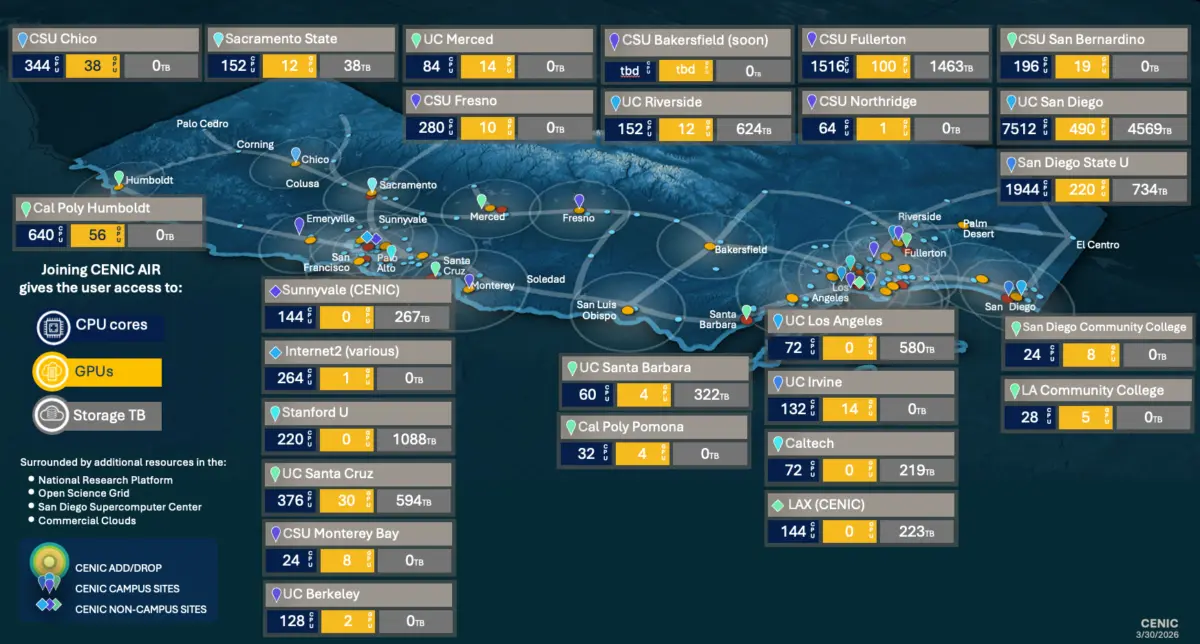
Wuerthwein made a compelling case for CENIC AIR as a valuable asset available to every college in California, regardless of its financial or technical resources or location. He noted that CENIC AIR’s strategy is to centralize those activities that become cheaper with scale (e.g., system administration, cybersecurity, user support, and training) and to decentralize activities for which the costs scale linearly (e.g., hardware and power).
“Essentially, CENIC AIR enables California’s colleges to own their AI infrastructure, with CENIC doing the network planning, engineering, and coordination activities, including critical security functions,” said Wuerthwein. “This means that colleges aggregate the obstacles while retaining ownership of their infrastructure so they can bring digital assets to all classrooms.”
He also mentioned his private nickname for CENIC AIR (and NRP)— “The Museum of Nvidia”—as both resources include a broad variety of equipment from older and more budget-friendly to recently released and more powerful. Thus, the most expensive top-of-the-line equipment is not needed to participate in CENIC AIR and NRP as a hosting institution.
Wuerthwein’s presentation then outlined a path for colleges not currently on CENIC AIR to begin using it and learn how it can transform the research and education taking place on their campuses. He recommended that interested faculty and researchers set up an account and begin exploring the National Research Platform (NRP) and its various assets, including documentation and Zoom-based office hours. Once faculty and researchers become familiar with NRP and understand how best to apply it to their own institutions, they can investigate purchasing hardware and joining NRP.
Related blog posts

UC San Diego’s GAIA Initiative Promises Transformation of Atmospheric and Climate Research
The realization that predictive climate research could be transformed by networked compute and data resources led to a breathtaking variety of research institutes in California. The next step is to accelerate this transformation by coordinating the institutes themselves so that they can each act as force multipliers for one another and for atmospheric, ocean, and climate research as a whole. That is the purpose of UC San Diego’s GAIA Initiative.

CENIC Members Doing the Impossible in Weather and Climate Forecasting with CENIC AIR and Advanced Networks
Vastly improved bandwidth and the emergence of AI-enabled tools—such as those made possible for CENIC members with CENIC AIR and NRP—have created a whole new era in weather prediction, climate modeling, and disaster preparedness.

Recent blog posts
UC San Diego’s GAIA Initiative Promises Transformation of Atmospheric and Climate Research
Reimagining Supercomputing with the Distributed Bring-Your-Own-Resources Model
The CENIC AI Resource Powers Diverse Disciplines at CENIC Member Campuses
Experts Review Developments in Federal Funding Landscape at CENIC 2026 Conference
Subscribe to our newsletter
Stay up to date on news and stories from the CENIC community.