





Opening the Digital Future for the Next Generation
Solving the problems currently facing humanity requires engaging everyone, no matter who or where they may be, to combine varied ideas and experiences to find solutions. And advanced networks and the services they make possible can create even more productive ways to make that happen.
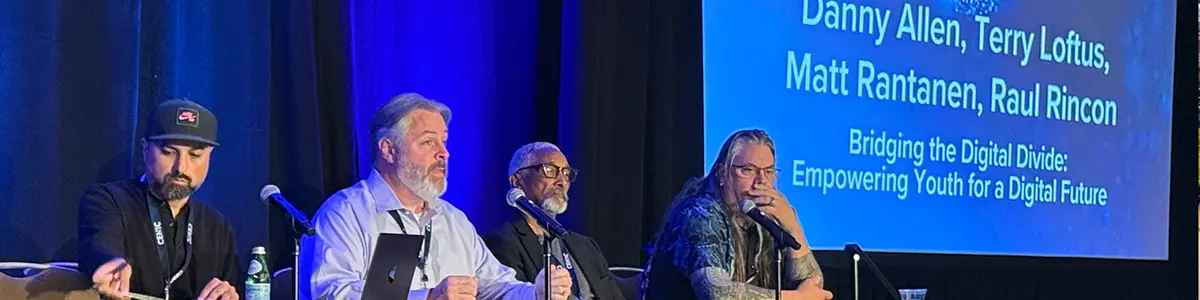
Danny Allen, Chief Executive Officer of djallen LLC, renowned for his international work on strategic partnerships with SAP Labs, agrees. During a panel discussion by thought leaders at the CENIC 2026 biennial conference, The Right Connection, Allen stated plainly, “The digital divide is at heart an economic one. The only way to solve big problems is through engaging diverse people to work together in teams. This means diverse in thought, experience, and perspectives, as well as people who are more economically challenged. We must look at how we use these technologies as a team to solve problems in ways that benefit everyone.”
Allen was joined by Matt Rantanen, Director of Technology for the Southern California Tribal Chairman’s Association and Director of the Tribal Digital Village; Terry Loftus, San Diego County Office of Education Assistant Superintendent and Chief Information Officer; and moderator Raul Rincon, Senior Vice President of Strategic Initiatives at CENIC.
Allen’s statement launched the discussion of what schools and communities can do to lower barriers to full engagement by those who will face the challenges of tomorrow. Among these barriers is the acquisition of the digital literacy skills needed to engage productively with the online world and broadband access, which, for many remote and rural communities, equates to availability and funding.
The Must-Haves: Digital Literacy, Availability, and Funding
“Our students need to learn the skills to successfully maneuver in online communities,” said Terry Loftus. “To do that, our students require connectivity to get online, access to the devices that make that possible, and also the agency and digital literacy to do so safely and securely.”
Allen noted that, like the digital divide itself, each of these requirements is fundamentally an economic challenge. “If you can solve the economic problems of providing all teens the tools they need, then we can get them working together in teams to solve big problems. However, today, the wealth gap is on steroids.”
Many federal sources of funding have been reduced or removed, requiring states to pick up efforts to increase connectivity and manage cybersecurity and device provision for students.
“K–12 education is under attack when it comes to funds from federal sources with the Department of Education going away,” said Loftus.
Matt Rantanen agreed, noting that it was helpful when funding went to tribes directly, which then supported design development tailored to their own needs with Tribal Broadband Bootcamps, which have served 95 tribes and over 500 attendees in the last four and a half years.
“In Indian country, there are no cookie-cutter solutions,” said Rantanen. “Depending on location, knowledge, or funding, connectivity can be about fiber to the home, wireless, or just connectivity to community buildings, as that’s where the devices are. With the Bootcamps, we focus on talented Tribal community members ages 16 and up, who have a lot of knowledge and digital proficiency with iPhones and games. They know how to run an extremely time- and cost-efficient network with few resources.”

Artificial Intelligence and the Digital Curb-Cut Effect
The promise of artificial intelligence (AI) tools to democratize access to the resources needed not just to inhabit but create the future was noted as an extremely positive development.
“AI tutors for those in any field will really help teams acquire added knowledge and skills,” said Allen. “They can help a student really absorb the material or bridge a gap during which mentoring isn’t available.” He also discussed the ways in which AI tools can help build new hackathon-like teaching models that emphasize teamwork alongside more individually oriented ones.
Loftus pointed out that the adaptability of AI tools also holds the promise of far-reaching curb-cut effects. “It’s particularly valuable to focus on where the need is greatest,” he said, “since that’s where you see truly transformational changes.”
The effect is named for the creation of now-ubiquitous curb ramps during the 1970s to provide wheelchair users with greater mobility. To this day, these ramps are used even more frequently by delivery drivers, senior citizens, parents with strollers, and others. Closed captions are another example; they are created for deaf and hard-of-hearing communities but are often used by hearing viewers in noisy environments or who find it easier to engage visually. According to Loftus, this effect and its potential to positively ripple through the whole of society could be among the most exciting aspects of using AI to develop solutions for those with the greatest needs, such as students with disabilities, families facing disparities in healthcare access, or rural schools and communities lacking robust infrastructure.

Security and Data Sovereignty Issues Also Paramount
However, the excitement of many people at the promise of AI tools is often matched by security and intellectual property concerns. Loftus, for example, noted the security issues that arise when AI work and engagement are tracked—and what other downstream effects might lurk. “AI tools now are beneficial for students, but I worry about the use of AI as companions and how we protect students’ mental health,” he added.
Rantanen mentioned cloud-related issues, which were of particular interest to Tribal nations. “The issue for tribes is data security with the use of the cloud for data,” he said. “How do we know they’re using it correctly? What about data sovereignty? How do we ensure the continued sovereignty of data and information if we’re using a cloud service? We need to work through a range of legal issues to understand the connection with Indian law and sovereignty law.”
All panelists agreed that AI will accommodate many more needs than can be imagined today, which led to a discussion of the value of applying the principles of universal design to the challenge. For example, solving one problem often leads to beneficial outcomes for other issues, whether by generalizing solutions or freeing up resources that can be used to overcome other challenges.
Danny Allen closed the session by noting that there remain those individuals and foundations who retain an interest in social impact. “We need to find out how to focus on the outcomes that will unleash those types of philanthropic funds to narrow the divide for the next generation.”
Related blog posts

Experts Review Developments in Federal Funding Landscape at CENIC 2026 Conference
At the 2026 CENIC biennial conference, The Right Connection, attendees heard from top policy analysts stressing that building and sustaining relationships with representatives and agencies in D.C. remains as important as ever in the current federal funding climate.

CENIC Members Bolster the Economy by Expanding Digital Literacy in California
Members of CENIC are working to improve digital literacy by supporting initiatives aimed at creating digital access for more Californians and by creating programs to enhance digital literacy once those people have been connected.

Recent blog posts
UC San Diego’s GAIA Initiative Promises Transformation of Atmospheric and Climate Research
Reimagining Supercomputing with the Distributed Bring-Your-Own-Resources Model
The CENIC AI Resource Powers Diverse Disciplines at CENIC Member Campuses
Experts Review Developments in Federal Funding Landscape at CENIC 2026 Conference
Subscribe to our newsletter
Stay up to date on news and stories from the CENIC community.