




Blog: Category Archives: RENS & NRENS
Progress Towards “Future-Proofing” CENIC’s Network
In support of CENIC’s new spectrum service offering, engineers worked creatively to overcome obstacles posed by the ongoing pandemic including remote collaboration and supply chain slowdowns. The team successfully augmented the spectrum termination capabilities in Los Angeles and in Sunnyvale by 16 flexible grid capable ports, each with the capacity to terminate services between 100G and 800G. This new infrastructure is capable of supporting colorless, directionless, and contentionless (CDC) technologies, which are prerequisites for enabling software provisioning in the optical layer.
The Minds We Need: Federal Broadband Investment Should Include Research and Education Infrastructure
As the federal government considers a major investment in broadband, members of the research and education community, including CENIC, Internet2, The Quilt, and EDUCAUSE, came together this spring to support and publish The Minds We Need.

Life Inside CENIC: Sana Bellamine and Core Engineering
Sana Bellamine works in Core Engineering, which is instrumental in connecting millions of Californians with reliable and forward-thinking solutions, from basic broadband to advanced services with experimental networks.
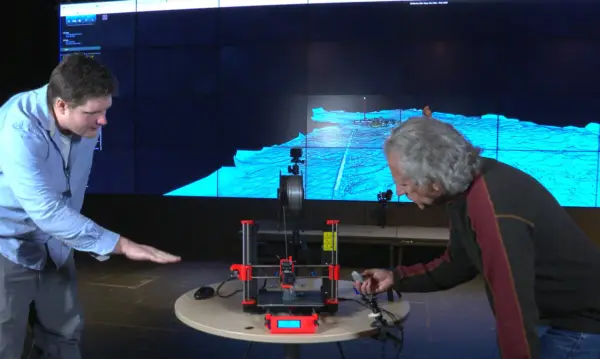
Virtual Excavations: Pacific Research Platform Enables Remote Collaboration on Underwater Archeological Dig in Israel
Supported by CENIC's 400-gigabit research network, the Pacific Research Platform has not only enabled researchers at UC San Diego and their partners at the University of Haifa in Israel to go ahead with their archeological dig despite the COVID-19 pandemic but also drastically accelerated data analysis times.

CENIC 2020 & 2021: Wrapping Up and Looking Ahead
We look back at CENIC's achievements in 2020 and look ahead to the goals we continue to pursue in 2021.

Life Inside CENIC: Lee Ann Weber and the Communications Department
The communications team’s work is driven by CENIC’s mission to advance education and research statewide by providing the world-class network essential for innovation, collaboration, and economic growth. We share our knowledge and serve as an advocate for public policy that advances broadband access for all.
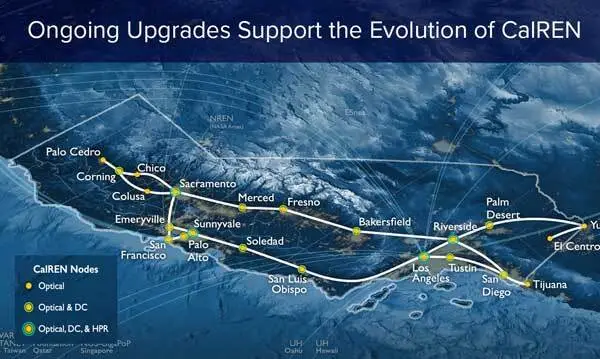
Ongoing Upgrades Support the Evolution of CalREN
In accordance with our strategic plan, CENIC staff are completing network upgrades that will ensure network reliability, deploy cost-saving technologies, decrease our environmental footprint, and enable high-capacity services.
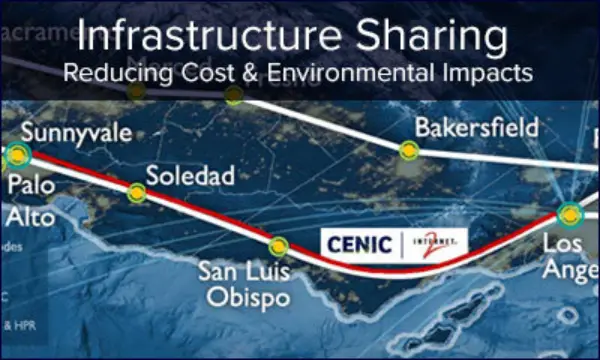
Coastal Path Upgrades Represent a Milestone in Infrastructure Sharing Between CENIC and Internet2
The completion of 400G upgrades represents a milestone in infrastructure sharing between CENIC and Internet2 as both networks move to higher-bandwidth technologies and seek to reduce both cost and environmental impact.

Internet Exchange Points: An Essential Infrastructure for Rural Broadband Initiatives
IXPs are one of the building blocks around which the Internet is built. They are the physical locations where networks come together, and where content providers place content closer to end users to increase the speed and efficiency of networks. Currently, there are dozens of IXPs nationwide but most of them are concentrated in big cities. Increasing the number of IXPs across California will result in a more resilient, competitive, and interconnected Internet (especially for households in more rural areas).

California Cultural Institutions Increase Online Initiatives During COVID Pandemic
CENIC’s member cultural institutions have launched innovative digital initiatives to reach people at home during the pandemic, providing valuable resources for the research and education community and beyond.