


Fiber to the Farm: The Iron Horse Vineyards Testbed
Louis Fox, President & CEO of CENIC
In December 2024, leaders from CENIC and Iron Horse Vineyards gathered in Joy Sterling's living room and asked what would happen if a working farm had the same network, computing, and data infrastructure as a research university. What if growers, researchers, and students worked on that farm together?
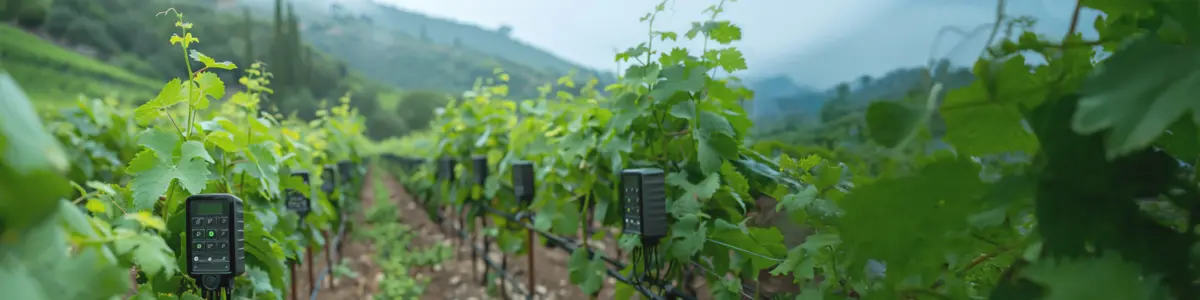
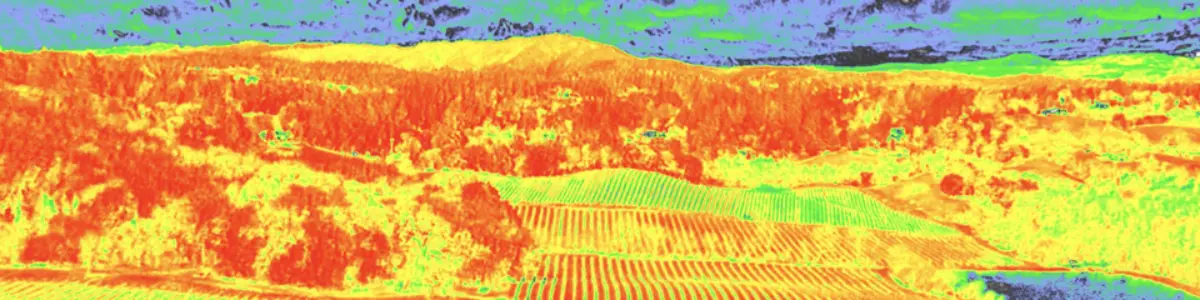
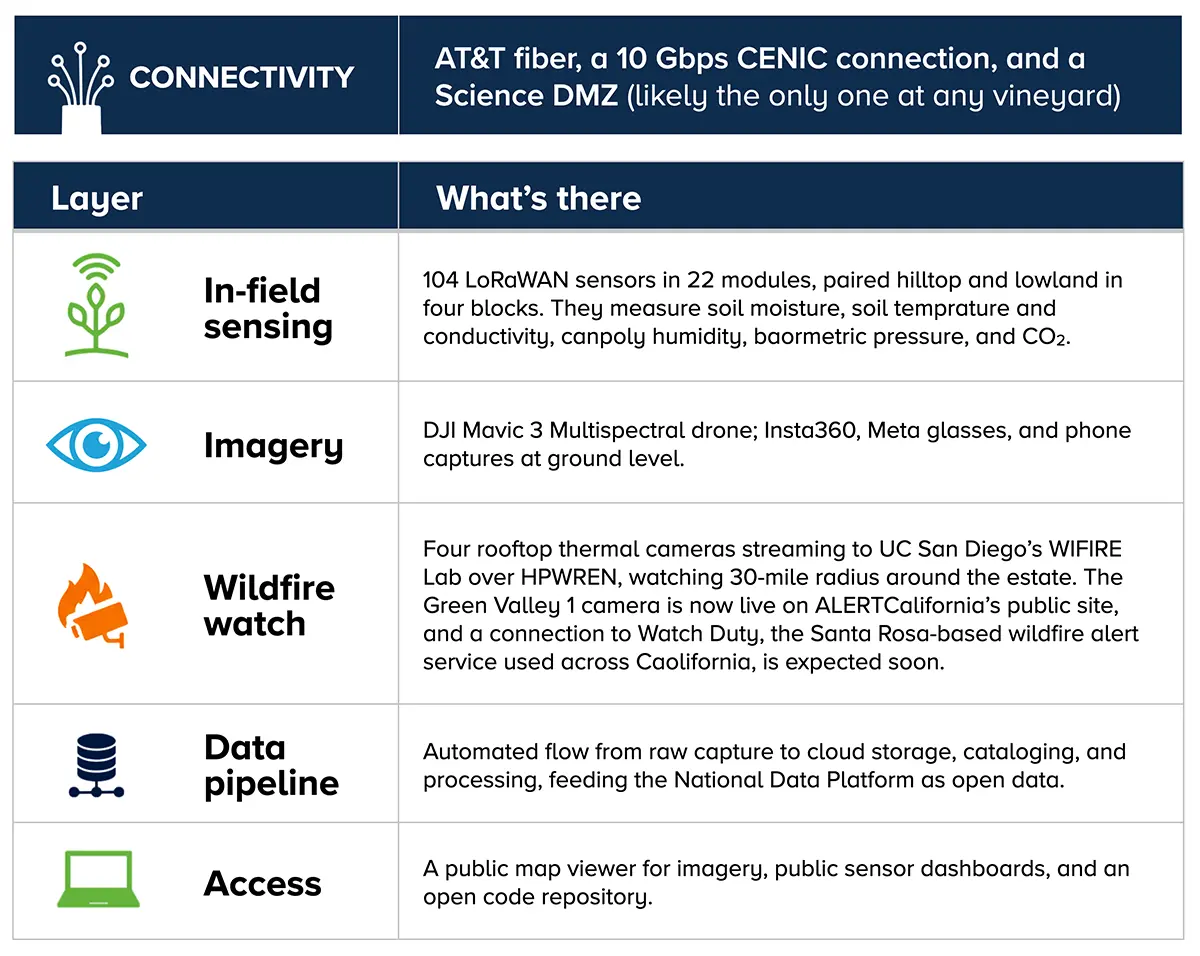
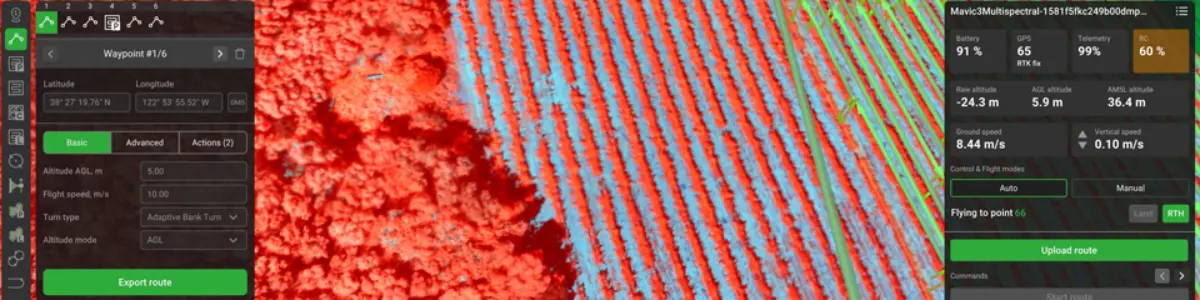
In 2026, Iron Horse ran its fiftieth harvest, its first as a fully instrumented testbed, and the earliest on record. AT&T fiber and a 10 Gbps CENIC connection link the vineyard to California's research and education network. More than a hundred sensors, a multispectral drone, and wildfire cameras feed an open data pipeline used by UC San Diego, the San Diego Supercomputer Center (SDSC), and students from Sonoma State University and Santa Rosa Junior College.
The vineyard is where we started, not where we are headed. Everything built at Iron Horse was designed to work on any farm, and it is now being extended to campus farms across California. This document explains why we began here, what the first season taught us, and what comes next.
Why a Vineyard, and Why Iron Horse
People sometimes ask why a project about the future of agriculture began at a premium winery. It's a fair question. The answer is that we were looking for the right place to build and test a model, and Iron Horse offered what a first site needs.
A host who wanted to be a testbed. Joy Sterling served on the FCC's Precision Agriculture Connectivity Task Force, which advised the FCC and USDA on bringing broadband to America's farmland. One of its recommendations was that agriculture needs testbeds: real farms where growers can see what becomes possible when connectivity truly exists. Joy offered her own farm, opened its data to the public, and brought her advocacy and her network with it. A host like that is rare, and it made everything else possible.
A hard problem. Vineyards are among the hardest crops to capture in data: moving leaves, shifting light, dense canopies, and thousands of nearly identical shapes. Imaging and modeling methods that work in a vineyard should carry over to orchards, row crops, and pasture.
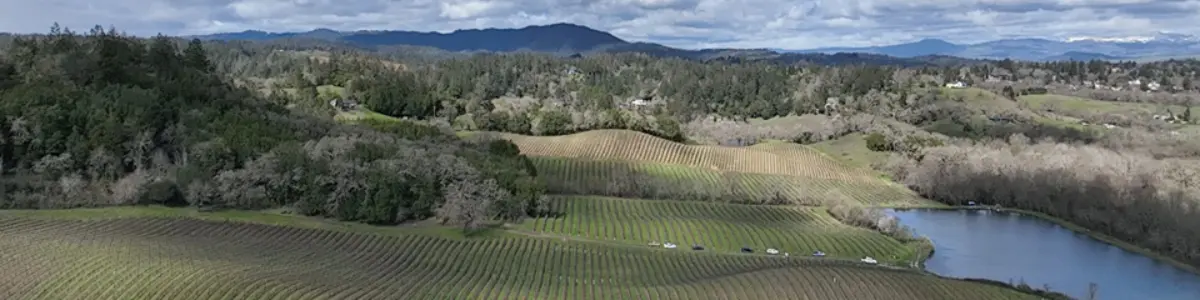
A natural laboratory. Iron Horse has hilltop blocks where water drains away and low blocks where fog settles, in a cool, foggy part of west Sonoma County. Fifty vintages of grower knowledge give the instruments something to be checked against.
Students nearby. Sonoma State University and Santa Rosa Junior College both have strong viticulture programs a short drive away.
Nothing in it is specific to wine. Fiber to the farm, a Science DMZ, wireless soil and air sensors, multispectral drones, wildfire cameras, and an open data pipeline work on any farm. Soil moisture, accumulated warmth, and early signs of crop stress matter for almonds, tomatoes, and rangeland as much as for Pinot Noir.
The Model: Research, Education, and Practice on One Farm
Most agricultural technology efforts serve one audience: researchers studying a crop, students learning on a teaching plot, or vendors selling to growers. The testbed brings all three to the same working farm, on the same network, using the same open data.
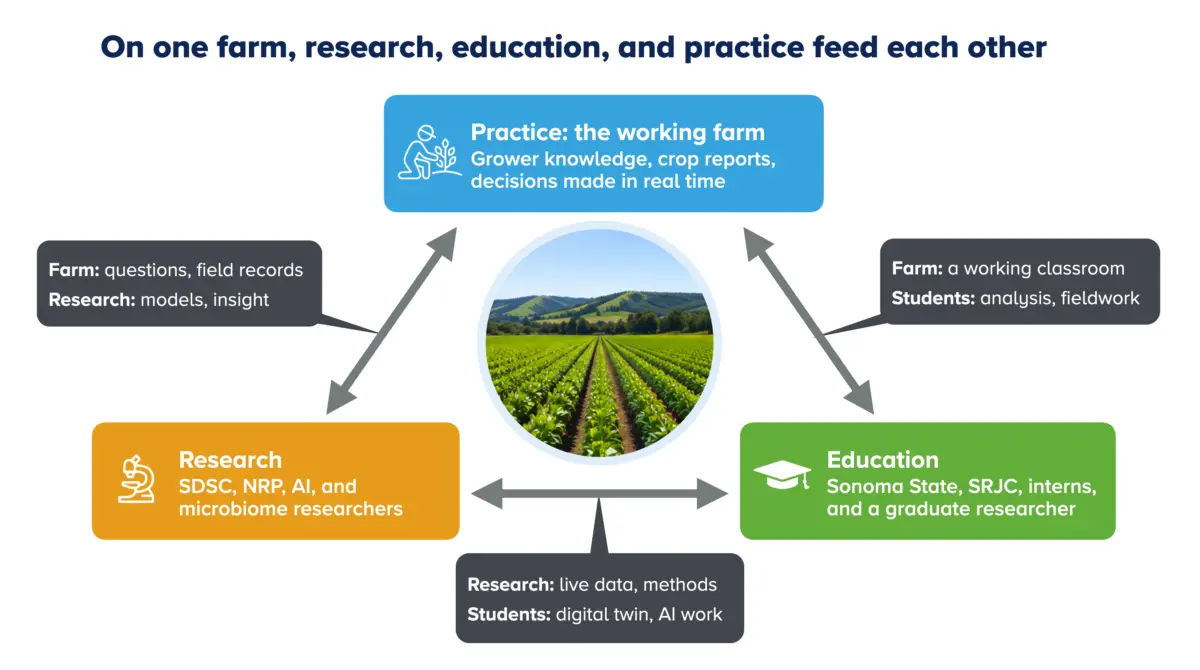
The farm gives researchers real questions and gives students a working classroom. Research gives the farm models and insight, and gives students live data and methods. Students do much of the analysis and fieldwork, and they become the next generation of growers and agricultural technologists. CENIC's network connects all three, so a student at Sonoma State, a researcher at SDSC, and a winemaker in Sebastopol can work on the same data at the same time.
What's Built
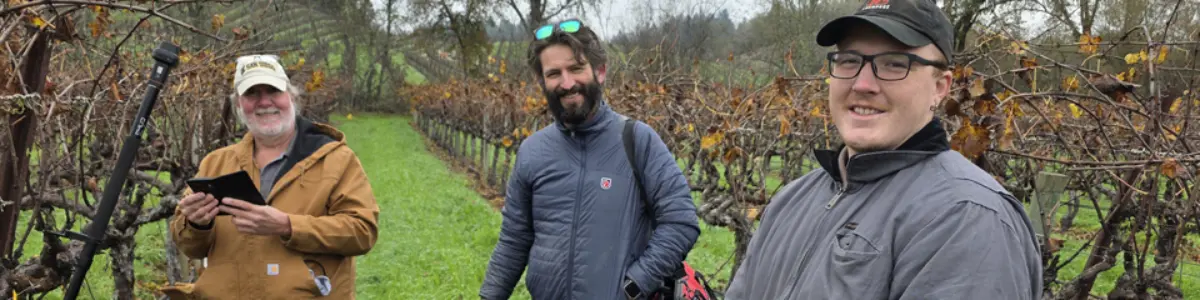
None of this works without the last mile, and AT&T made the last mile happen. In spring 2025, AT&T brought fiber to the farm, and CENIC installed a 10 Gbps router. That gave a family winery in west Sonoma County the same kind of connection a research university has. Sensors went into test locations that August and into their permanent blocks over the fall and winter. When budbreak came two and a half weeks early in 2026, the instruments were already recording.
Partners include:
- Iron Horse Vineyards: Host farm, grower and winemaker knowledge, field records, and open data
- AT&T: Last-mile fiber to the farm
- CENIC and CENIC AIR: Network, project leadership, and connections to member campuses
- UC San Diego, SDSC, and the National Research Platform: Computing, storage, the data pipeline, AI and digital-twin work, and WIFIRE
- Sonoma State University: Student researchers working on AI and the digital twin
- Santa Rosa Junior College: Student participation beginning next semester
- UC Agriculture and Natural Resources: Agricultural research partner
What the First Season Taught Us
Iron Horse picked its first fruit of 2026 on July 27. About a dozen vintages ago, harvest began in the second week of August, and before that, at the end of August. As Joy Sterling put it, 2026 is not the fiftieth entry in an old record. It is the first entry in a new one.
On the farm
- What matters is warmth that adds up, not the daily high. Budbreak came two and a half weeks early even though there was no obvious heat spike. The cause was a run of mild nights after a dry January. The vineyard will now keep a running total of growing degree days from its own weather station. That total would have flagged the season in February.
- Instruments and field observation need each other. Weekly crop reports dated bloom to a cold, wet, and foggy April, which explained uneven fruit set across the estate. The sensors recorded the weather, and the field reports showed which weeks mattered. Neither would have found it alone.
- The season showed where to measure next. Some blocks reached three-quarters bloom while others were at 1 percent. Next season's sensors will go at both ends of that range.
In research
- A full year of continuous soil data has drawn soil-microbiome researchers, along with an offer from Larry Smarr to help fund genetic sequencing of the soil.
- With a complete season of imagery, researchers have begun training computer-vision models to identify vines, canopy vigor, and signs of stress automatically. The plan is a family of models, some general and some focused on tasks such as locating trunks, measuring canopy vigor, or spotting pests and disease, whose results are then combined.
- Five years of historical crop reports from the vineyard's inspection service now give the sensor data a longer record to be read against.
In education
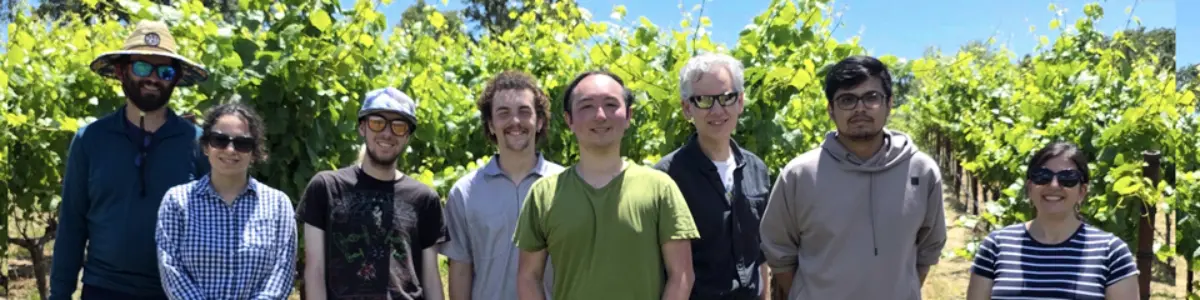
- Sonoma State students are using the data for AI projects and to build a 3D digital twin of the vineyard. Students have held internships both on site and on the National Research Platform.
- Santa Rosa Junior College students join next semester, and student interns will install the next round of sensors.
- Joseph Ording, a graduate researcher on CENIC's staff, built much of the data pipeline and is leading the early modeling work.
What Nobody Predicted
The computers on Iron Horse's Science DMZ inspired a new CENIC project: helping libraries run their own AI models on hardware they control. Infrastructure built for a vineyard became a template for something else entirely. That kind of spillover is a big part of why testbeds are worth building.
Still Early, and That's the Point
The testbed is one season old. Year one went mostly into building a reliable foundation for collecting, storing, and sharing data, and into learning, with the field as a check, which measurements matter. That foundation is now in place, and the instruments have already caught and corrected their own early errors by being tested against what the vineyard showed.
The most important work ahead is connecting the data more closely to the specific decisions a winemaker and vineyard team make: when to irrigate, where to thin the canopy, how to protect against frost, and when to pick. That will take more seasons of data, an even closer partnership between growers and the data team, and tools built around the grower's questions. One season can't set a baseline either. 2026 was an unusual year, and with El Niño arriving, 2027 may be too.
The judgment will stay with the grower. Sugar and acid can be measured, but the decision to pick is still made by tasting in the rows. The testbed's job is to give growers better information about the conditions around the fruit, not to replace them.
These lessons also point toward campus farms, where precision agriculture is itself the subject being taught and studied. Experimenting is already their purpose, and what they learn can flow back to commercial farms like Iron Horse.
What Comes Next
Season two is when the record starts to become a baseline.
- Student interns and CENIC staff will install new sensors, including soil temperature at root depth to catch the moment the vines wake up.
- Five years of crop reports will show whether the same blocks lead and lag every year, which will guide where sensors go.
- Analysis moves from building the pipeline to building models. One goal is to predict water stress before the vines show it, ahead of late-season heat.
- The map viewer will add ground-level imagery, sensor data, and scouting notes, so growers and researchers can work in one place.
- Soil-microbiome sequencing is planned, depending on funding. Beyond Iron Horse, the infrastructure and open pipeline are being extended to CSU, community college, and UC campus farms, across crops well beyond grapes. The goal is a network of testbeds whose data can be compared, and that students anywhere in California can learn from.
An Invitation to Other Farms and Campuses
A new site does not need to be a vineyard, or even a commercial farm. Here is what Iron Horse suggests a site needs:
- A committed host, willing to open the farm to researchers and students
- A grower or farm manager with time to work with the data team
- An academic partner with students who want to learn on a working farm
- Connectivity, or a path to it, which CENIC can help find
- A few concrete starting questions to decide where sensors go
- Existing records, such as crop reports, soil tests, and harvest notes, to give new data some history
- Patience for at least two seasons
- A willingness to share data openly
CENIC and its partners bring the network, the open pipeline and tools built at Iron Horse, computing through SDSC and the National Research Platform, and connections to researchers and teaching programs across California.
One piece of advice from going first: start the conversation between growers and researchers on day one. Agree early on the few decisions the data is meant to inform, and set up simple record-keeping, such as crop reports, scouting notes, and harvest decisions, before the sensors arrive.
Acknowledgements
A testbed is only as good as the people willing to go first. We owe particular thanks to a few of them.
AT&T. The last mile is always the hardest mile, and on a farm it is often the mile that never gets built. AT&T built it. Their fiber turned an idea into a working connection, and they have stayed engaged as the project has grown. Everything else in this document depends on that link.
Joy Sterling and Iron Horse Vineyards. The case for agricultural testbeds came partly from Joy's own work on the FCC task force, and she was ready to make it real on her own land. She opened her farm, her records, and her fiftieth harvest to researchers and students. She insisted from the start that the data be open to everyone. Her account of this first season is one of the most thoughtful descriptions of what the testbed is teaching. We are grateful as well to winemaker David Munksgard and to the vineyard team, including Jose Puga and Manuel Briano, whose decades of knowledge of this ground are what the instruments are learning from.
Tom DeFanti. Tom has led this work for CENIC with remarkable energy and care. He has been in the vineyard planting sensors, and he connected CSU and community college viticulture programs to the project. He recovered five years of crop reports and brought soil-microbiome researchers to the table. Above all, he keeps asking the most important question: is this actually useful to the people who farm? After a career at the frontier of visualization and research networking, he has brought that same rigor and curiosity to a hillside in Sebastopol. This project would not be where it is without him.
We also thank John Graham and colleagues at SDSC and the National Research Platform; Joseph Ording; Larry Smarr; the students and faculty of Sonoma State University and Santa Rosa Junior College; and UC Agriculture and Natural Resources.
Learn More
- IHV map viewer | Project code repository
- CENIC and Iron Horse Vineyards: one-year anniversary
- SDSC, "Farm-to-Table via Supercomputer"
- National Research Platform, "At the Heart of Precision Agriculture"
- Iron Horse Vineyards, "Innovation in the Vineyard"
Related blog posts
UC San Diego’s GAIA Initiative Promises Transformation of Atmospheric and Climate Research
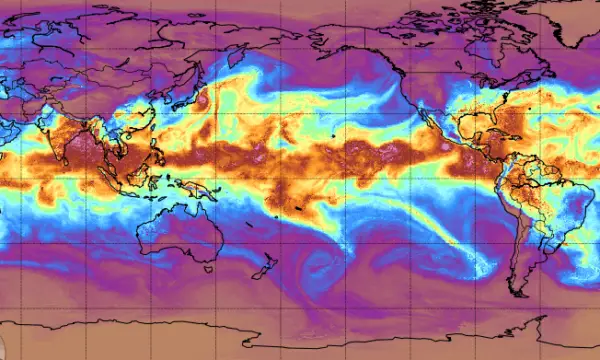
The realization that predictive climate research could be transformed by networked compute and data resources led to a breathtaking variety of research institutes in California. The next step is to accelerate this transformation by coordinating the institutes themselves so that they can each act as force multipliers for one another and for atmospheric, ocean, and climate research as a whole. That is the purpose of UC San Diego’s GAIA Initiative.
CENIC Members Doing the Impossible in Weather and Climate Forecasting with CENIC AIR and Advanced Networks
Vastly improved bandwidth and the emergence of AI-enabled tools—such as those made possible for CENIC members with CENIC AIR and NRP—have created a whole new era in weather prediction, climate modeling, and disaster preparedness.

Recent blog posts
Pacific Wave Powering Demonstrations at Upcoming 2026 Supercomputing Conference
UC San Diego’s GAIA Initiative Promises Transformation of Atmospheric and Climate Research
Reimagining Supercomputing with the Distributed Bring-Your-Own-Resources Model
The CENIC AI Resource Powers Diverse Disciplines at CENIC Member Campuses
Subscribe to our newsletter
Stay up to date on news and stories from the CENIC community.