





Broadband-enabled Energy Innovations for Anchor Institutions: the latest from CENIC's California Broadband, Energy, and the Environment Series
The infrastructure required to run broadband networks requires increasing amounts of power, but those same networks can enable innovations that anchor institutions can use to better manage their power consumption -- as long as their own internal networks are designed to make use of them.
To examine these factors, CENIC is pleased to present the latest installment of its California Broadband, Energy, and the Environment Series, outlining how anchor institutions can use these innovations to manage their energy use and some of the factors they must keep in mind when designing their internal networks to support them.
Broadband-enabled Energy Innovations for Anchor Institutions
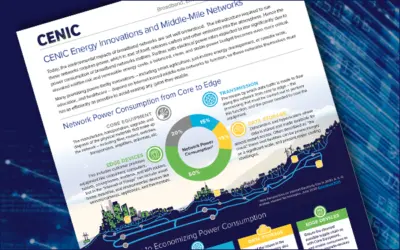
Anchor institutions’ unique uses of broadband come with increased use of bandwidth and energy, but broadband also brings with it the ability to actively manage their energy usage.
Engineers tasked with local decisions on network design must think about efficiencies that can be created through better visualization of their resource usage and integrated designs.
CENIC Energy Innovations and Middle-Mile Networks
Motivated by a desire to scale for the future while using its and its members’ resources as efficiently as possible, CENIC has achieved dramatic improvements in network-related power, equipment, and service provision.
By implementing power- and process-related efficiencies, CENIC was able to reduce its network power use from 343,000 to 106,000 kWh/month – a major cost savings and reduction in power consumption of over two-thirds and the equivalent of powering 270 households while still increasing capacity for its member communities. Learn More & Download >
To learn even more about middle-mile networks including what they are, what they will do for last-mile networks and their customers, the service products they could deliver, how they connect into the existing Internet, and how public and private networks work together, download CENIC’s Middle-Mile Network Series.
Related blog posts
Reimagining Supercomputing with the Distributed Bring-Your-Own-Resources Model
As society becomes more reliant on large-scale supercomputing centers for compute and storage, the costs associated with them have become a topic of discussion. One innovative hypercluster model—a distributed one—provides an alternative approach.

The CENIC AI Resource Powers Diverse Disciplines at CENIC Member Campuses
Learn how researchers at non-R1 institutions or those who need only a handful of GPUs can benefit from CENIC AIR, which can catapult their work to the next level and enable them to collaborate and compete with peers from larger, better-resourced institutions.
Related content
BlogAnswering Your Questions about Middle-Mile Networks: a series from CENIC
BlogMinding Our MANRS: CENIC and Global Internet Routing Security
BlogThe Future of Network Automation at CENIC

Recent blog posts
UC San Diego’s GAIA Initiative Promises Transformation of Atmospheric and Climate Research
Reimagining Supercomputing with the Distributed Bring-Your-Own-Resources Model
The CENIC AI Resource Powers Diverse Disciplines at CENIC Member Campuses
Experts Review Developments in Federal Funding Landscape at CENIC 2026 Conference
Subscribe to our newsletter
Stay up to date on news and stories from the CENIC community.