





APOnet Regional Cooperation Ensures Uninterrupted Connectivity
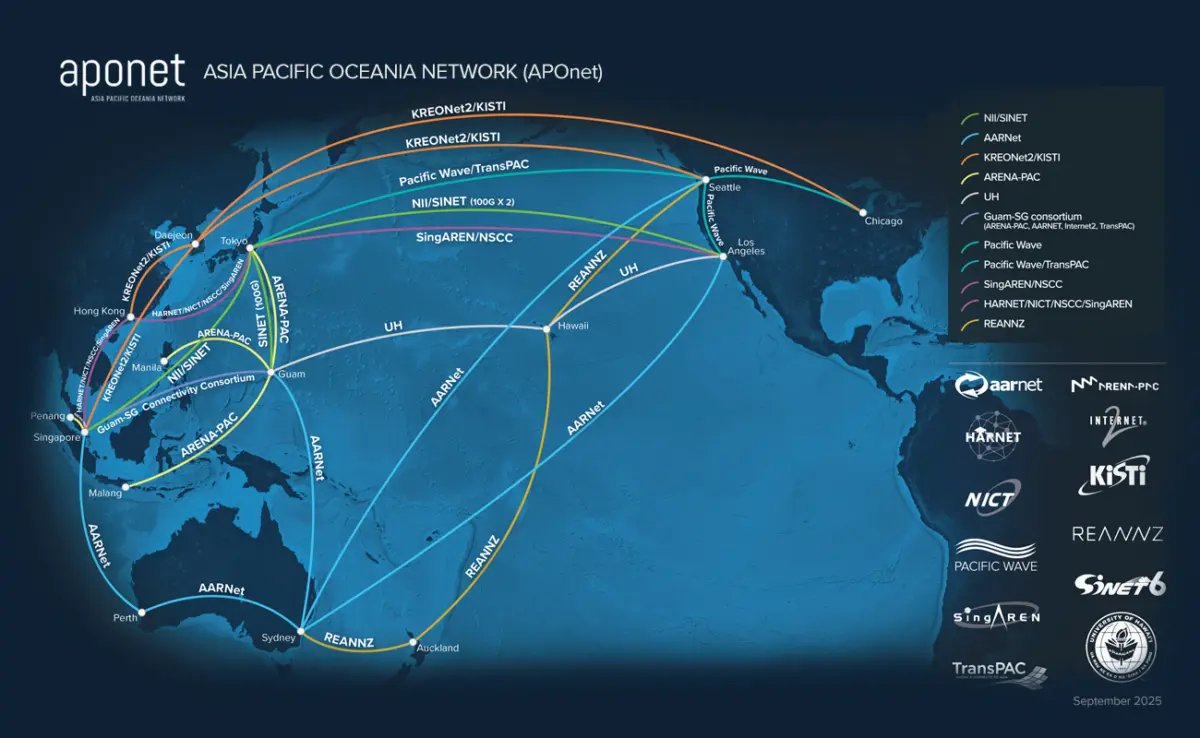
When the JGN Tokyo-Hong Kong-Singapore line *1 , operated by the National Institute of Information and Communications Technology (NICT), a Japanese National Research and Development Network, was scheduled to provide backup for the suspension of the Japanese academic backbone network, Science Information Network (SINET), for two months, the importance of regional cooperation exemplified by the APOnet framework really came to light.
APOnet is a consortium of twelve leading-edge research and education networks in North America, East Asia, Southeast Asia, and Oceania, working together to improve high-speed network services in the Asia Pacific Oceania region. Read More >
Related blog posts

Pacific Wave Powering Demonstrations at Upcoming 2026 Supercomputing Conference
One of the over 20 demonstrations supported by Pacific Wave at SC26 is a three-part demonstration of the USC Information Sciences Institute’s Security and Privacy Heterogeneous Environment for Reproducible Experimentation (SPHERE) research infrastructure. This NSF-supported infrastructure is designed for at-scale, realistic and reproducible cybersecurity and privacy experimentation across very diverse hardware.

Network Strategies to Predict, Plan, and Prepare for Disasters
At the recent CENIC 2026 biennial conference, a panel of national networking experts discussed what disaster response means for major research and education networks, including proactive planning to ensure that critical connections and services are maintained when needed most. The panel was moderated and led by Louis Fox, Chief Executive Officer of CENIC.

Recent blog posts
Pacific Wave Powering Demonstrations at Upcoming 2026 Supercomputing Conference
UC San Diego’s GAIA Initiative Promises Transformation of Atmospheric and Climate Research
Reimagining Supercomputing with the Distributed Bring-Your-Own-Resources Model
The CENIC AI Resource Powers Diverse Disciplines at CENIC Member Campuses
Subscribe to our newsletter
Stay up to date on news and stories from the CENIC community.